On the night of 16–17 September 2026 photographer Florian Riou caught giant red sprites above the village of Montemaggiore near Calvi, Corsica; his pictures went viral in October. Sprites are flashes 50–90 km up, just below the edge of space, set off by powerful lightning, and they last a few milliseconds. The storm was near Barcelona, about 500–700 km away: at that distance the clouds are below the horizon, but the sprites are still about 5° above it. Our take: a lovely reminder that the sky over the sea can hide a storm and still show its fireworks.
Atmosphere at the edge of space · red sprites · Corsica
Giant red “jellyfish” over a Corsican village: what was photographed?
French photographer Florian Riou set up his camera in Montemaggiore, a hill village near Calvi in Corsica, on the night of 16–17 September 2026. What he caught looks like huge red jellyfish hanging in the sky above the houses. His pictures spread across social media in October and many people asked: is this real, and is it space?
It is real, and it is a red sprite: a flash of light 50 to 90 kilometres up, high above a thunderstorm. It lasts only a few milliseconds, so the eye almost never catches it. The surprise is where the storm was: not over Corsica at all, but near Barcelona, roughly 500 to 700 kilometres away across the sea.
How can a storm 600 km away appear above the village?
Because of Earth’s curvature. At that distance the thunderclouds, whose tops reach about 12 km, have already sunk below the horizon. Our calculation on a round Earth shows that a cloud top 600 km away sits about 1.6° below the horizon, while a sprite 80 km up is still about 5° above it. So the photographer sees the sprite floating over the rooftops with no storm in sight.
Sprites are set off by especially powerful lightning strokes, usually positive ones, that dump a lot of charge into the ground in one go. For a moment this leaves a strong electric field above the cloud, and the thin air high up breaks down and glows. The red colour comes from nitrogen.
Height≈ 50–90 km
Lastsa few milliseconds
Photographed fromMontemaggiore, near Calvi (Corsica)
Stormnear Barcelona, ≈ 500–700 km away
Night16–17 September 2026
Edge of space100 km (Kármán line)
Why the sprite shows and the storm does not
Original Astrometrik animation; heights and Earth’s curvature are exaggerated. A lightning stroke flashes in the distant storm, then a red sprite lights up 50–90 km above it for a split second. The dashed line is the photographer’s horizon: the cloud stays below it, the sprite rises above it.
Is it space? Almost
Space is usually said to begin at 100 km, the Kármán line. Sprites live just below it, in the mesosphere, a layer too high for planes and balloons and too low for satellites. That is why they were only confirmed on camera in 1989, and why some of the best views come from above: astronauts on the International Space Station photograph them looking down on storms.
Since 2018 the European ASIM instrument, mounted outside the station’s Columbus module, has been watching sprites, blue jets, “elves” (huge glowing rings about 90 km up) and bursts of gamma rays from thunderstorms, to understand how lightning and space connect.
Sprite or aurora?
Both are red and both are high, but they are cousins at most. The aurora is powered from space: particles from the Sun, funnelled by Earth’s magnetic field, and it can glow for hours. A sprite is powered from below, by a thunderstorm, and is gone in a few thousandths of a second. If the red light pulses with lightning far away, it is a sprite.
How to photograph sprites
Find a big thunderstorm 200–700 km away with a clear sky between you and it, a dark place and a low, open horizon. Aim just above the storm, use a sensitive camera and record video or many short exposures, then look frame by frame. Late summer and autumn storms over the warm Mediterranean are a good season. Never stand under the storm itself.
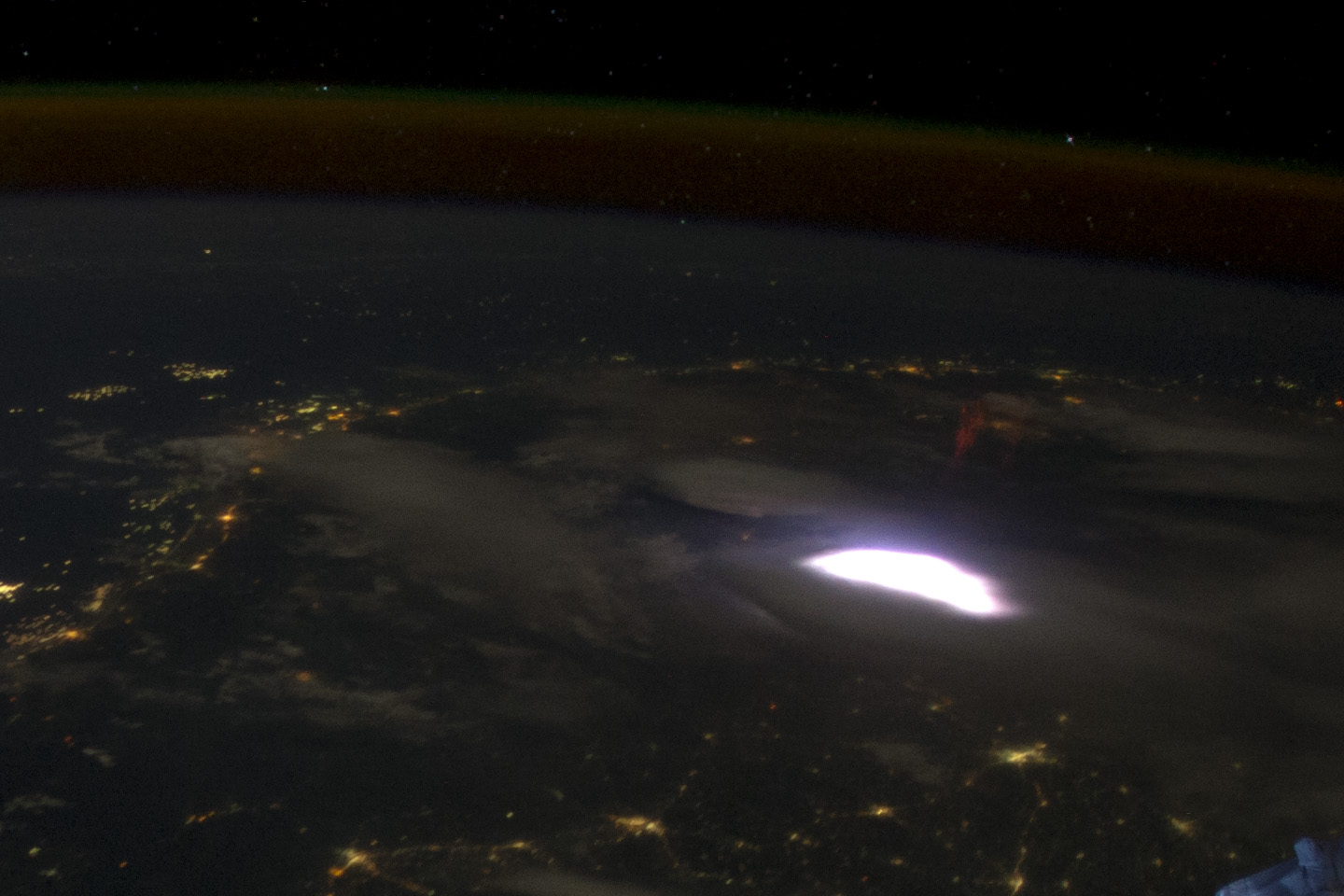
A red sprite seen from the International Space Station
Photographed by the Expedition 31 crew on 30 April 2012 as the ISS passed from central Myanmar towards Malaysia: the red sprite rises above a bright lightning flash. Image: NASA Earth Observatory / ISS crew (public domain).
Move the storm: when do you see the sprite but not the cloud?
Choose how far away the storm is. We calculate how high a sprite (50–90 km) and the cloud tops (12 km) appear above your horizon.
Watch the station that sees them from above
Astronauts on the ISS photograph sprites over thunderstorms. Our ISS page shows when the station passes over your sky tonight.
What are the red lights over Corsica in the viral photos?
Red sprites: flashes of light 50–90 km above a thunderstorm, lasting a few milliseconds. Florian Riou photographed them from Montemaggiore near Calvi on the night of 16–17 September 2026.
Where was the storm?
Near Barcelona, about 500–700 km away. At that distance the storm clouds are below the horizon, but the sprites, being far higher, are still a few degrees above it.
Are red sprites a space phenomenon?
They happen just below the edge of space (100 km), in the mesosphere. They are caused by lightning, not by the Sun, and astronauts on the ISS often photograph them from above.
Can I see a red sprite with my own eyes?
Rarely, because it lasts only milliseconds and is faint. Cameras recording video from a dark site, aimed above a distant storm, catch them far more often.
Sources and calculation
Sources: L’essentiel (12 October 2026) and UkrMedia (10 October 2026) on Florian Riou’s photos from Montemaggiore, night of 16–17 September 2026, storms near Barcelona about 500–700 km away; NASA Earth Observatory, “Elusive Sprite Captured from the International Space Station” (photo ISS031-E-010712, 30 April 2012); ESA, Atmosphere–Space Interactions Monitor (ASIM). Elevation angles calculated by Astrometrik on a spherical Earth without atmospheric refraction. We do not show Florian Riou’s photos here because they are his copyright; the link above leads to them.
Positions and times were recalculated with Astronomy Engine, the sky-calculation library Astrometrik uses; times for Vienna and Istanbul are local time. The artwork on this page was drawn by Astrometrik.